A homeowner on the Sammamish Plateau lists a quarter-acre resale this month. Historically, offers land in about a week. What they want to buy next is a townhome inside Sammamish's Town Center, the kind of walk-to-the-library, walk-to-Metropolitan-Market home that doesn't yet exist in the quantity they need to comparison shop.
That mismatch, not the price tag, is the actual friction for anyone trying to sell a traditional Plateau home and buy into the new Town Center product in the same year. The resale side of Sammamish still moves in single-digit days. The new-construction side is arriving in phases, from specific builders, on specific blocks, and won't offer a real range of comparable listings for a while yet. Anyone planning that trade needs to understand both clocks before writing a contract that assumes they run at the same speed.
Two Indices That Disagree, and Why That's the Real Signal
Over the three months ending June 2026, Redfin recorded a median Sammamish sale price of $1.6 million, down 3.3 percent from the same period a year earlier, with homes selling in about nine days. Zillow's home value index for the same general window showed a much steeper decline, down 12.7 percent year over year. Those two numbers describe the same city and land more than nine points apart.
That gap isn't a data error. It's what happens when the mix of what's closing changes faster than either index can smooth out. A city-wide median blends everything that sold that month. If most of what closes is large-lot Plateau resale, the median sits one place. If a growing share of what closes is attached, smaller-footprint new construction, the median moves without a single existing homeowner's equity changing at all. That's arithmetic, not appreciation or decline, and it's exactly the effect Town Center is built to produce as its for-sale inventory comes online.
King County's own assessor's office runs into a version of this problem every year, which is why its mass appraisal reports apply a formal time-adjustment factor to every sale before drawing conclusions from it. The methodology used for the North and South Sammamish Plateau assessment areas exists because raw sale prices drift across a single assessment year, and comparing them without accounting for timing produces a false picture. If the county treats sale timing as a variable worth correcting for, a homeowner sizing up their own equity should treat composition the same way.
What's Actually Rising Behind Sammamish Commons
The reason the mix is shifting has a name, and it's not abstract. Town Center's for-sale housing is arriving from two specific builders in two specific phases.
| Project | Builder | Product | 2026 Status |
|---|---|---|---|
| Parkside Sammamish (formerly Brownstones West) | Terrene Homes | Townhomes | Under construction at 222nd Place SE and SE 4th Street, releasing in phases |
| TerraLuxe (formerly Brownstones East) | Taylor Morrison | Townhomes | Scheduled to arrive fall 2026 |
| Core mixed-use blocks (Blocks 5 through 7) | Innovation Realty Partners | 156 apartments, 144 senior-restricted units including a Merrill Gardens community, roughly 88,000 square feet of ground-floor retail | Construction expected to start in 2026 and run 18 to 24 months |
| Assisted living and memory care site, east side of 228th across from Metropolitan Market | Aegis Living | 95 to 100 units | Developer had targeted a first-quarter 2026 groundbreak, subject to market conditions |
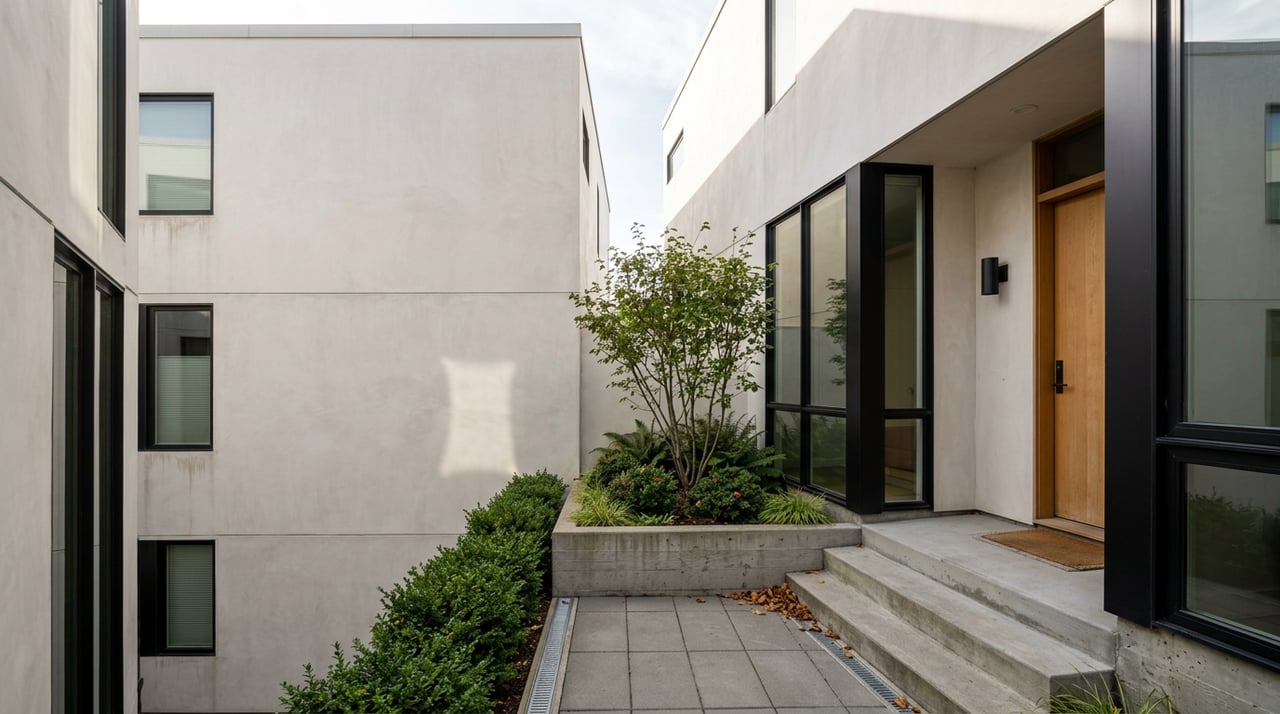
Together, Parkside and TerraLuxe add roughly 86 townhomes to what was, until recently, a small and largely civic footprint anchored by Sammamish Commons, City Hall, the Sammamish Community and Aquatic Center, and the King County library branch. The Sammamish Independent has reported that road and stormwater work tied to the project, including new segments of SE 5th, SE 6th, and 224th along with a regional stormwater vault funded at roughly $5.2 million through developer contributions, was targeted for completion by spring 2026.
None of this is speculative land banking. It's permitted, funded, and in the ground.
The Vote That Keeps Moving the Comparison Set
The scale of what's coming isn't fixed at 86 townhomes and two apartment towers. In a 6-1 vote on July 15, 2025, the Sammamish City Council adopted what the city calls Action Alternative 1, raising the Town Center housing target from 2,000 units to 4,000 and shifting the zoning approach to a hybrid form-based code.
The city's own Town Center housing page is explicit about the intent behind that number. Sammamish has, in the city's words, a surplus of large single-family homes that serve a specific phase of life, and the update is designed to widen the mix toward housing that works for younger households, older residents, and anyone who wants something other than a large detached home. The city's planning documents note that lower-density product like townhomes carries a higher land cost per unit, which is why the updated code leans toward apartments, condominiums, and middle housing rather than more market-rate townhomes as the primary way to add supply.
For a Plateau seller, that policy detail matters more than it looks. It means the comparison set an appraiser draws from a year or two from now won't just include more Town Center product than today. It will include a different kind of Town Center product than what's delivering in 2026, shifting again as the plan moves toward its 4,000-unit horizon.
The Timing Problem: A Nine-Day Market Meeting an Eighteen-Month Build
Here is where the two clocks actually collide for a household trying to make this trade work.
Selling a Plateau or Trossachs-style resale in the current market typically means an accepted offer within about a week to nine days, based on the most recent quarterly figures. That's fast enough that a seller often can't simply wait for their next home to be ready before listing. But buying into Town Center means buying into a product that arrives in batches. Parkside is releasing in phases. TerraLuxe follows in the fall. A buyer hoping to shop a range of comparable Town Center listings before committing will instead find themselves comparing new construction to new construction from the same builder, on the same block, in the same phase, which narrows the room to negotiate price precisely when a seller most wants that flexibility.
That timing gap changes what a home-sale contingency needs to do. In the tightest Eastside submarkets, sellers typically won't hold a contingent offer open much past three to four weeks. That window works fine when the buyer's target home already exists and simply needs an accepted offer. It works less cleanly when the target home is a phase of construction that hasn't released yet, or a mixed-use block still 18 to 24 months from completion. A seller who wants to move into Parkside or TerraLuxe this year is often better served by locking in a purchase position first and building the resale timeline around that construction schedule, rather than assuming the two will land in the same month by coincidence.
There's a second, quieter tradeoff buyers face inside Town Center specifically. Buying early, while cranes and stormwater work are still visible from the front door, typically comes at a discount for the inconvenience. Buying once the core blocks are finished and occupied comes at a premium for a visible, functioning neighborhood. Neither choice is wrong, but it's worth deciding on purpose rather than by default.
A Few Questions Worth Asking Before You List
Does the Town Center rezone lower my Plateau home's resale value? Not directly. A quarter-acre lot with established landscaping and Lake Washington School District boundaries isn't in direct competition with a townhome three blocks from a stormwater vault. What it changes is the citywide median you'll see quoted in headlines, which increasingly reflects a blended mix rather than a single market.
Will a Town Center townhome appraise cleanly if I buy pre-completion? Appraisers lean on the tightest available comparable set, and early in a phased release that set is thin and entirely new construction. Expect the appraisal conversation to focus on your specific building and phase rather than a broad neighborhood average, since that average doesn't really exist yet.
How long should my contingency window be if I'm trying to time both sides? Long enough to account for the builder's release schedule, not just the resale market's typical pace. A nine-day resale timeline is the easy part. The construction and permitting calendar on the other side of the trade is the one worth mapping out first.
Sammamish's Town Center is still early in a build-out that will keep reshaping what "median price" means in this city for years. If you're weighing a sale on the Plateau against a move into what's rising near Sammamish Commons, the sequencing matters as much as the pricing. The Danna Team works through that kind of two-sided timing with clients across the Eastside every year, and we're glad to walk through what it looks like for your specific address. Schedule a Private Consultation with The Danna Team to start mapping your timeline.